Start with one complete free trial, then explore ten run-anywhere simulations of active matter, soft matter and statistical mechanics — written in pure Python and sold as one-time packs of four. Open a notebook in Google Colab, press Run all, watch the physics happen, then turn the dials yourself. No ffmpeg, no LAMMPS, nothing to install.
Every notebook ships in two modes: assisted loads the bundled data and shows the result instantly, and full runs the whole simulation from scratch so you can reproduce and change it. Each pack includes the notebooks, their data files, and a plain-language README that explains the physics without assuming a PhD.
Try the interaction rule now
No signup and no installation: switch between non-reciprocal chasing, equal reactions, and territorial attraction. The browser sketch runs the same cyclic species rule explored quantitatively in the free notebook.
● LIVEcoral → cyan → gold → coral96 particles
drag through the field to disturb it · switch the interaction rule and watch the world reorganise
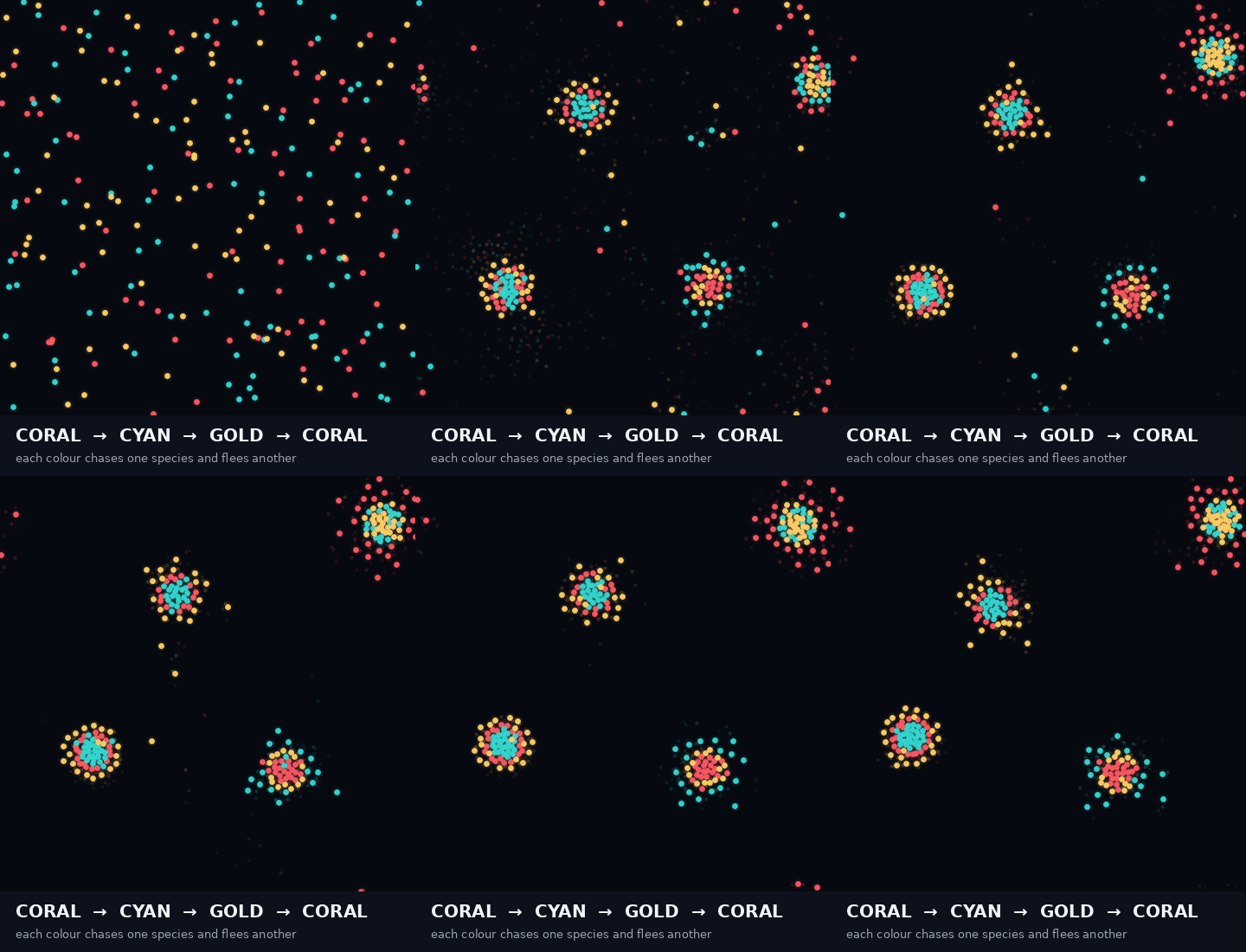
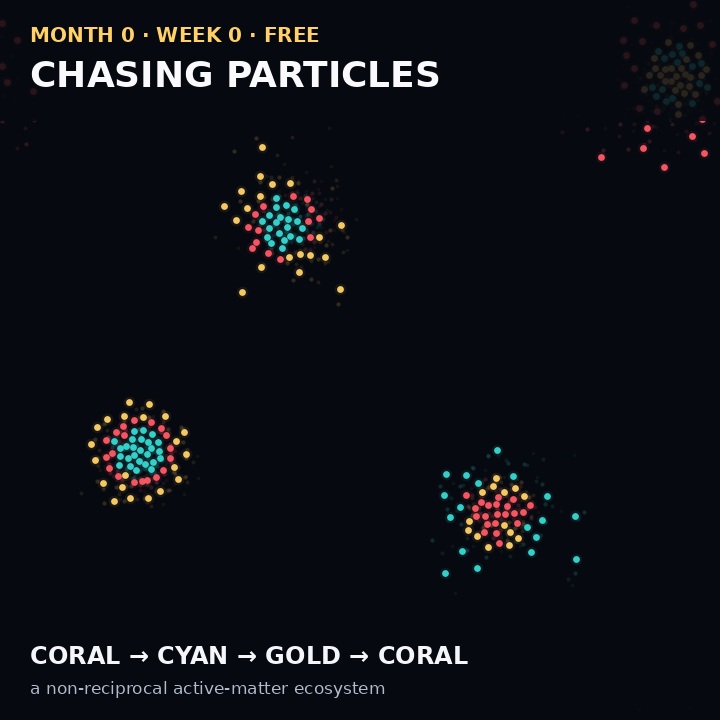
Coral chases cyan, cyan chases gold, and gold chases coral. Watch a random gas build travelling packs, then edit the interaction matrix and invent a different world. Complete notebook, bundled data, and full simulation code.
Prices are in Indian rupees. Dodo converts the payment at checkout when needed. Weeks 9 and 10 are finished and will be released as Month 3 once that pack is complete.
The simulations
Eleven complete titles: Week 0 is the free trial, followed by ten paid notebooks with their own data files and READMEs. Paid weeks are sold in four-simulation packs.
WEEK 0
Chasing Particles
Coral chases cyan, cyan chases gold, and gold chases coral. A random gas reorganises into travelling packs and chase waves because the effective interactions break action-reaction symmetry. The complete interactive trial is free.
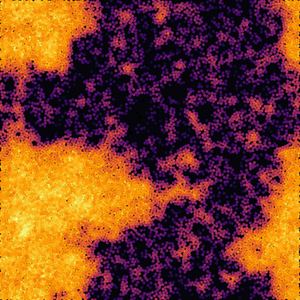
Self-propelled discs that only ever push each other apart — no attraction anywhere in the model — and yet above a certain crowding they separate into a dense phase and a dilute one. The founding result of active matter, with the crowding dial in your hands.
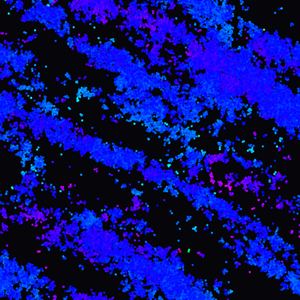
A thousand movers, no leader, one rule: steer the way your neighbours are heading. A flock snaps into being every time. Turn the noise up and find the exact point where collective motion collapses.
A grid of tiny magnets. Cool it past the critical temperature and the whole sheet locks into one direction on its own. The textbook phase transition, animated, with the temperature yours to sweep.
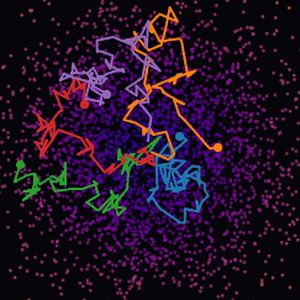
A speck jostled by molecules far too small to see. This is the random walk that convinced physics atoms are real — and you measure the spread growing linearly with time, exactly as Einstein predicted in 1905.
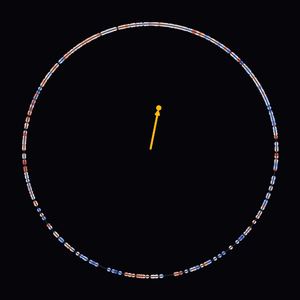
Thousands of oscillators, each with its own natural rhythm. Turn up the coupling and they snap into a single beat. The mathematics behind fireflies blinking together, metronomes on a shared board, and heart cells.
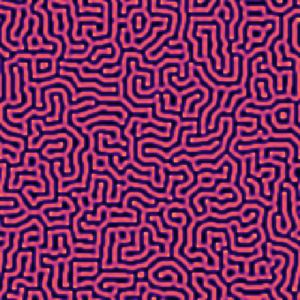
Two chemicals, spreading and reacting. Out of a featureless soup come spots, stripes, mazes and dividing blobs — Alan Turing's 1952 answer to how a leopard gets its spots, with the feed and kill rates as your dials.
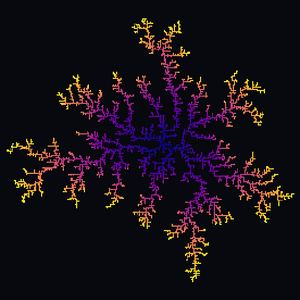
Random walkers drift in and stick on contact. What grows is a branching fractal of dimension 1.7 — the shape of snowflakes, lightning, mineral dendrites and soot. Measure the dimension from your own data.
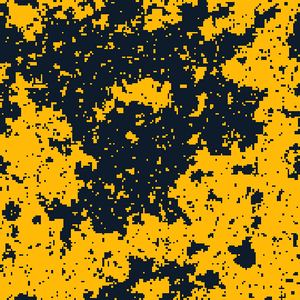
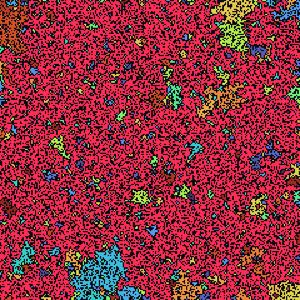
Fill a grid at random. Nothing happens, nothing happens — then at exactly 59.27% one cluster suddenly spans the whole thing. A sharp phase transition with no temperature in sight, and a number nobody put into the rules.
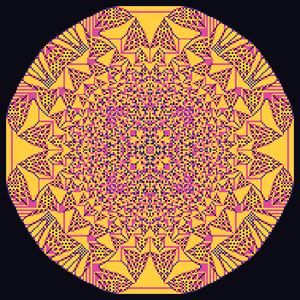
Drop grains until piles of four topple. The heap tunes itself to a critical point with nothing tuned — avalanches of every size, a power law straight across four decades. The model behind earthquake statistics.
Coming in Month 3
WEEK 10
The Self-Avoiding Walk
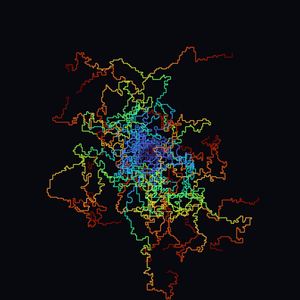
A polymer should be a random walk. It isn't: two beads cannot share a spot, and that one ban swells the coil to N^(3/4). Sampled with the pivot algorithm, and you measure the Flory exponent yourself.
Coming in Month 3
What you need to run them
A browser. Upload the notebook to Google Colab and press Runtime ▸ Run all. Nothing is installed on your machine.
Or your own Python.pip install numpy scipy matplotlib pillow jupyter ipywidgets, then open the notebook.
These are made for a laptop or desktop. They will run on a phone browser, but reading plots and sweeping parameters on a small screen is no fun.
Questions
Email contact@lovegrover.com and I will answer personally — including “does this cover X?” before you buy.